

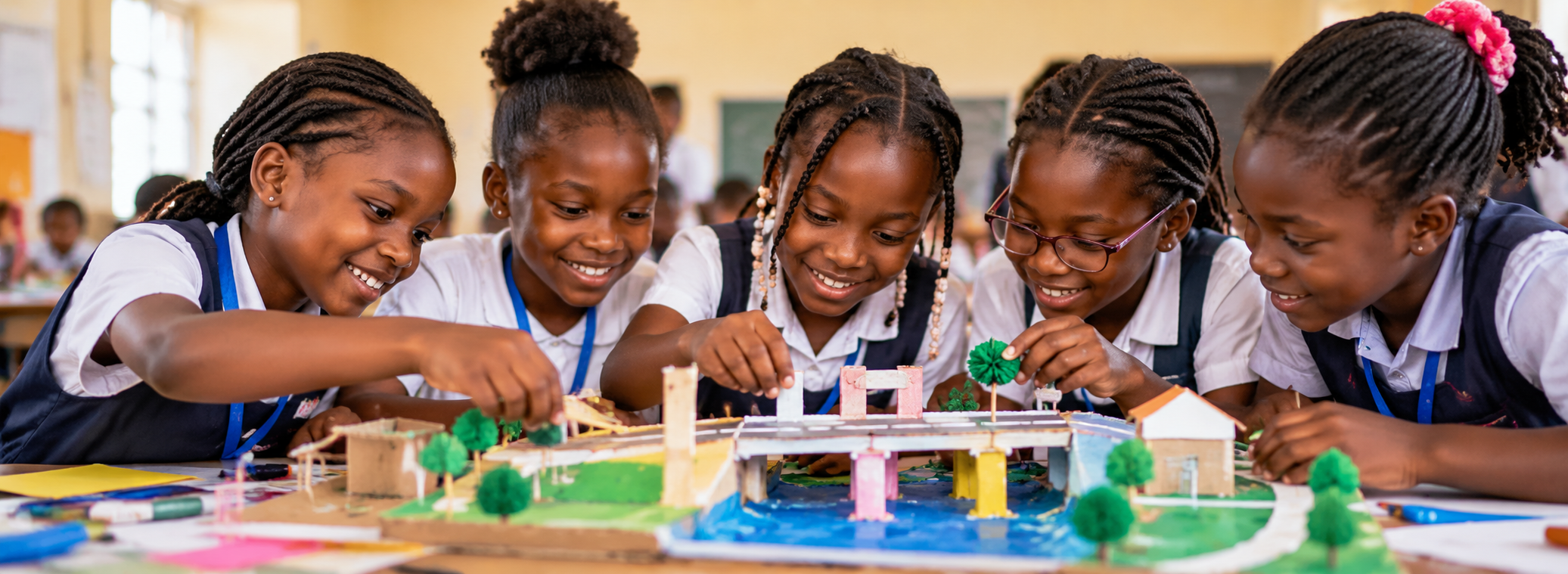
A STEM challenge can be a wonderful opportunity to discover science, technology, engineering, and mathematics. But it truly achieves its goal only when every girl can research, build, test, explain, and ask questions.
The goal is therefore not to select the “best student” very early on or to turn the activity into a recitation competition. The goal is to create a framework where girls with different profiles discover that they can contribute to a scientific or technical project.
A STEM challenge is not a recitation competition
Presenting a project clearly is useful. Yet, the quality of a presentation should not mask all the work done beforehand: observing a problem, imagining a solution, drawing a diagram, measuring, fabricating, testing, noticing an error, and starting over again.
A student who speaks little in front of the class can be excellent at spotting a flaw, organizing material, or proposing an improvement. Another may know how to simply explain what the team has learned. These different contributions are all part of STEM.
Before starting, the teacher can therefore announce a simple rule: the project will be evaluated on understanding, the approach taken, and collective work, not on memorizing a text.
Give each girl a real role
In a team, the roles must correspond to real tasks. For example:
- observe and question: identify the problem and ask the first questions; ;
- drawing or planning: representing the idea and planning the steps; ;
- to build or assemble: to participate directly in the realization; ;
- measure and test: verify what works and note the results; ;
- documenting and explaining: keeping a record of the experiments and presenting the findings.
These roles can change. Thus, one girl may not always be responsible for taking notes while another handles the equipment. Rotation allows each person to try several ways to contribute.
Make room for the most discreet girls
Asking “Who wants to answer?” often gives the floor to the same students. To broaden participation, a few simple practices can help:
- Let the girls exchange for two before speaking in front of the whole group; ;
- ask each team to collect an idea from each member; ;
- Allowing a shared presentation rather than a long individual speech; ;
- ask specific questions: “What did you change after your first try?”; ;
- Valuing a relevant question as much as a correct answer.
Participation does not mean forcing a child to speak for a long time in front of everyone. It means giving them a visible responsibility and a safe way to make their idea heard.
Transforming the error into a project step
In a real technical project, the first test rarely works perfectly. A paper bridge may collapse, a small car may veer off course, a circuit may not light up. These moments are valuable if the class learns to ask “Why?” and “What can we change?”
The teacher or the student can keep a record of three elements: the initial idea, what happened during the test, and the chosen modification. This method reduces the fear of making mistakes and shows that STEM is based on observation and improvement, not just on the immediate correct answer.
Link the project to several STEM professions
Each activity can open a window onto different professions. Building a bridge model allows you to talk about civil engineering, architecture, technical drawing, and material control. Working on an intelligent pedestrian crossing can introduce you to electrical engineering, electronics, programming, urban planning, and road safety.
Presenting several professions avoids reducing STEM to computer science or the profession of engineer. One can also talk about technicians, electricians, geographers, mechanics, water specialists, maintenance professionals, and many other paths.
A simple preparation for the teaching team
Before launch, five decisions are sufficient:
- formulate a concrete question to be solved; ;
- provide accessible and safe equipment; ;
- define the roles and their rotation; ;
- to announce that testing and mistakes are part of the work; ;
- Prepare three summary questions about what the team has learned.
The final result matters, but the journey matters just as much. An imperfect model can reveal an excellent approach if the girls know how to explain their choices, their tests, and the improvements they propose.
What girls need to remember
At the end of the challenge, each participant should be able to say at least one thing they did, a difficulty they encountered, and a profession they discovered. This is how a school project becomes a first experience of belonging to STEM.
Does your school want to offer this experience to its students?
Discover the InventHER Challenge and the registration information on the page dedicated to schools.